Understanding Income Per Capita with Real Examples
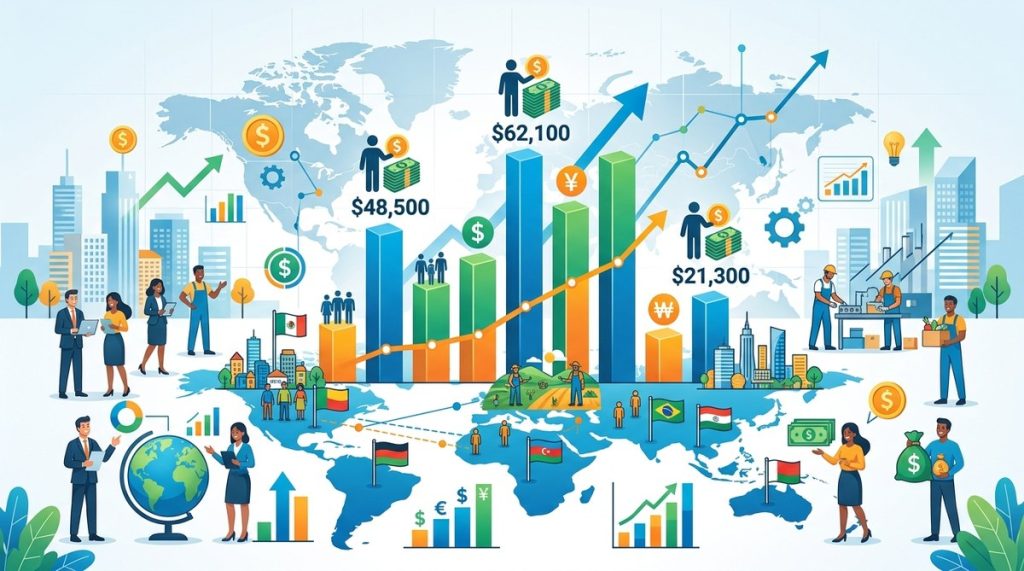
A lot of headlines in business and economics speak in terms like per capita income or GDP per capita, but what does that really mean for you or a country’s residents? At a glance these figures can feel abstract, yet they are powerful tools for understanding living standards, policy impact, and economic momentum. This article breaks down income per capita with real world examples, clear calculations, and practical guidance you can apply when you read the news or evaluate business opportunities. If you are a reader of weeklyavoid.com, you already expect practical, grounded analysis and here we bring you a thorough, friendly tour through real examples and the numbers behind them.
What is income per capita and why it matters
Income per capita is a basic way to gauge the average income earned by each person in a specific area, usually a country or a region. It is typically calculated by dividing the total personal incomes by the total population. The result provides a snapshot of how much income, on average, people have access to, and it can be a rough proxy for the standard of living in that area.
Quick definitions
- Per capita income: Total personal income divided by the population. This can include wages, salaries, and transfers such as pensions or social benefits in some definitions.
- GDP per capita: The value of all goods and services produced in a country divided by the population. It is a market based measure of output per person.
- GNI per capita: Gross national income per person, which adds income residents receive from abroad and subtracts income sent abroad by non residents.
- Median income vs mean (average) income: Median shows the middle point of all income data, while mean (per capita income) is the arithmetic average. In economies with large inequality, median income can tell a different story from mean per capita income.
Where it shows up
- Policy analysis: Comparing living standards across regions or over time.
- International comparisons: Assessing prosperity differences between countries.
- Economic forecasting: Understanding whether growth translates into broader well being.
- Business decisions: Firms may use per capita indicators to assess market potential or consumer demand in a region.
Real vs nominal income per capita
Most people encounter two related concepts: nominal income per capita and real income per capita. The difference lies in inflation.
- Nominal per capita income: The raw per person value without adjusting for changes in price levels. It tells you how much money people earn on average, but not how much that money can actually buy.
- Real per capita income: Nominal income adjusted for inflation, using a price index such as the Consumer Price Index (CPI) or an alternative like the GDP deflator. Real income shows buying power and living standards across time.
Why inflation matters
Inflation erodes purchasing power. If people earn more money but prices rise faster, their real living standards may not improve. When examining income trends over a decade, real per capita income is the more meaningful measure because it accounts for how much the same basket of goods and services costs over time.
The role of price indexes and PPP
- CPI based real income: Uses a fixed basket of goods common to households to track how prices move over time.
- Purchasing Power Parity (PPP): Adjusts for cost of living differences between countries, letting you compare what a given amount of money can buy in different places.
In practice, you will often see statements like “real per capita income rose by 2 percent in country X in 2025 after accounting for inflation.” If a country has rising prices, nominal income growth must beat inflation to translate into real gains.
How to calculate per capita income
While the exact data sources can vary by country, the core calculation is straightforward.
- Step 1: Identify the total personal income for a region (usually measured as all wages, salaries, and transfers in the national accounts context).
- Step 2: Identify the population of that region.
- Step 3: Divide total personal income by population to get per capita income.
- Step 4: (Optional) Adjust for inflation to get real per capita income.
- Step 5: (Optional) Adjust for cost of living differences using PPP to enable cross country comparisons.
Formula:
– Per capita income = Total personal income / Population
– Real per capita income = Per capita income × (Base year price level / Current year price level)
– PPP-adjusted per capita income = Real per capita income × (US price level / Local price level) [for cross country comparisons]
Example 1: A hypothetical country with inflation
- Total personal income (TPI) in a given year: $1,000,000,000,000
- Population: 50,000,000 people
- Nominal per capita income: 1,000,000,000,000 / 50,000,000 = $20,000 per person
Now suppose the price level has risen and the current year CPI is 125 while the base year was 100 (inflation of 25 percent).
- Real per capita income = 20,000 × (100 / 125) = $16,000
- Interpretation: Even though people appear to earn $20,000 on average in nominal terms, the higher price level means their purchasing power is equivalent to earning only about $16,000 in base year dollars.
Example 2: Another economy with growth but higher prices
- Total personal income: $600,000,000,000
- Population: 40,000,000
- Nominal per capita income: 600,000,000,000 / 40,000,000 = $15,000
Price level now is 135 (base 100, inflation of 35 percent):
- Real per capita income = 15,000 × (100 / 135) ≈ $11,111
- Observation: Even with a straightforward rise in total income, inflation erodes real gains, so living standards may not improve as much as raw numbers suggest.
Example 3: PPP adjusted cross country comparison
- Country A real per capita income: $28,000 (in local currency converted to USD)
- Local price level is higher than the US by 20 percent (PPP index: 120 vs 100)
- PPP-adjusted real per capita (to reflect purchasing power) ≈ 28,000 × (100 / 120) ≈ $23,333 in US purchasing power terms
- Why use PPP: It helps you compare what people can actually buy in different countries, rather than just comparing nominal or real incomes that are tied to local price levels.
Real world interpretation: what these numbers tell us
- Real per capita income helps you interpret whether economic growth benefits the average person, not just the economy as a whole.
- A rising real per capita income generally signals improving living standards, assuming income gains are evenly distributed and cost of living is stable.
- City or regional per capita income can reveal gaps within a country, highlighting areas with higher affordability and those with higher living costs.
The limitations and caveats
- Averages hide inequality: Per capita income is an average. It does not reveal how income is distributed across households.
- Median is often more telling for standard of living: In markets with high income inequality, the median income may indicate a different reality than the mean per capita figure.
- Data quality varies: Not all countries publish the same definitions or timeliness for personal income and population data.
- Non-market activities: In some economies, large portions of income come from informal work or transfers that may not be fully captured in official tallies.
- Cost of living differences: Even real per capita income does not fully reflect local living costs; PPP adjustments help but are not perfect.
How to compare across regions and over time
- Always check the base year when you see real per capita figures. A different base year can make trends look stronger or weaker than they truly are.
- Distinguish between growth due to population changes and growth in income per person. A country can have growing nominal GDP per capita simply because population growth slows, even if per person income is flat.
- Use PPP for international comparisons: When you want to understand how many goods and services a person can actually buy, PPP-adjusted figures are more meaningful than raw currency conversions.
- Look at both short term and long term trends: Inflation can spike temporarily; real per capita growth over several years is a better indicator of sustained improvements.
Practical takeaways for readers
- When you read news about a country’s income levels, identify whether the figure is nominal per capita income, real per capita income, or GDP/GNI per capita.
- If the article mentions inflation, pay attention to whether the figure is adjusted for inflation to see real changes.
- For cross country comparisons, look for PPP adjusted figures to get a clearer sense of actual purchasing power.
- Remember that per capita income is an average. Look for additional context such as income distribution and regional disparities when evaluating living standards.
Real world applications: what this means for policy and business
- Policy design: Governments use real per capita income trends to calibrate social programs, tax policy, and education spending. If real incomes stagnate while prices rise, targeted support may be needed.
- Economic forecasting: Businesses may analyze per capita income trends to forecast consumer demand, adjust pricing strategies, or determine market entry potential in different regions.
- Investment decisions: Investors use real income measures to gauge consumer buying power and the potential for durable goods, housing, and services within a market.
Quick tips to interpret per capita income in everyday life
- Consider the context: A rising per capita income in a country with rapidly rising prices may not translate into better living standards.
- Check data definitions: Look for whether the figure uses GDP, GNI, or personal income as the numerator.
- Pay attention to base year and currency conversions: Both affect real and PPP adjusted figures.
- Use multiple indicators: Combine per capita income with median income, poverty rates, unemployment, and cost of living indices for a fuller picture.
Frequently asked questions
What is per capita income?
Per capita income is the average income earned by each individual in a specific area, typically calculated by dividing total personal income by the population.
How is per capita income calculated?
Total personal income divided by the population. To obtain real per capita income, adjust for inflation using a price index such as the CPI.
Why is per capita income important?
It helps gauge average living standards, monitor economic progress over time, and compare prosperity across regions or countries.
What are the limitations of per capita income?
Averages obscure distribution, may not reflect cost of living, and data quality varies. It may misrepresent the realities of people at different income levels.
How do I compare per capita income across countries?
Use PPP adjusted figures to account for cost of living differences. Also consider median income and distribution to understand inequality.
How does real per capita income differ from GDP per capita?
Real per capita income measures the average purchasing power of residents after inflation, while GDP per capita reflects output per person. They can move differently if growth is concentrated or if price levels shift.
How often are these numbers updated?
Data updates vary by country and agency. Many countries publish annually or quarterly releases with revisions as more complete data becomes available.
Can per capita income tell me about poverty?
Not directly. It signals average income levels, which can mask poverty pockets. Look at poverty rates, income distribution measures, and social indicators for a fuller picture.
Conclusion
Understanding income per capita, especially in its real form, equips you to read economic headlines with sharper comprehension. By focusing on real per capita income and PPP adjusted figures, you gain insight into how much people can actually buy and how living standards evolve over time. The numbers themselves are informative, but the story they tell becomes clearer when you consider inflation, cost of living, distribution, and data quality. At weeklyavoid.com we aim to translate these metrics into practical takeaways for readers who want to understand business, tech, health, and entertainment through a clear, grounded lens. Whether you are weighing a potential market entry, interpreting a policy proposal, or simply trying to understand the economic news, real per capita income provides a pivotal lens through which to view prosperity and opportunity.